Crypto Ad Network for App Install Campaigns
Learn how a crypto ad network for app install campaigns can improve reach, relevance, and CPA app campaigns for mobile growth.
On this page0%
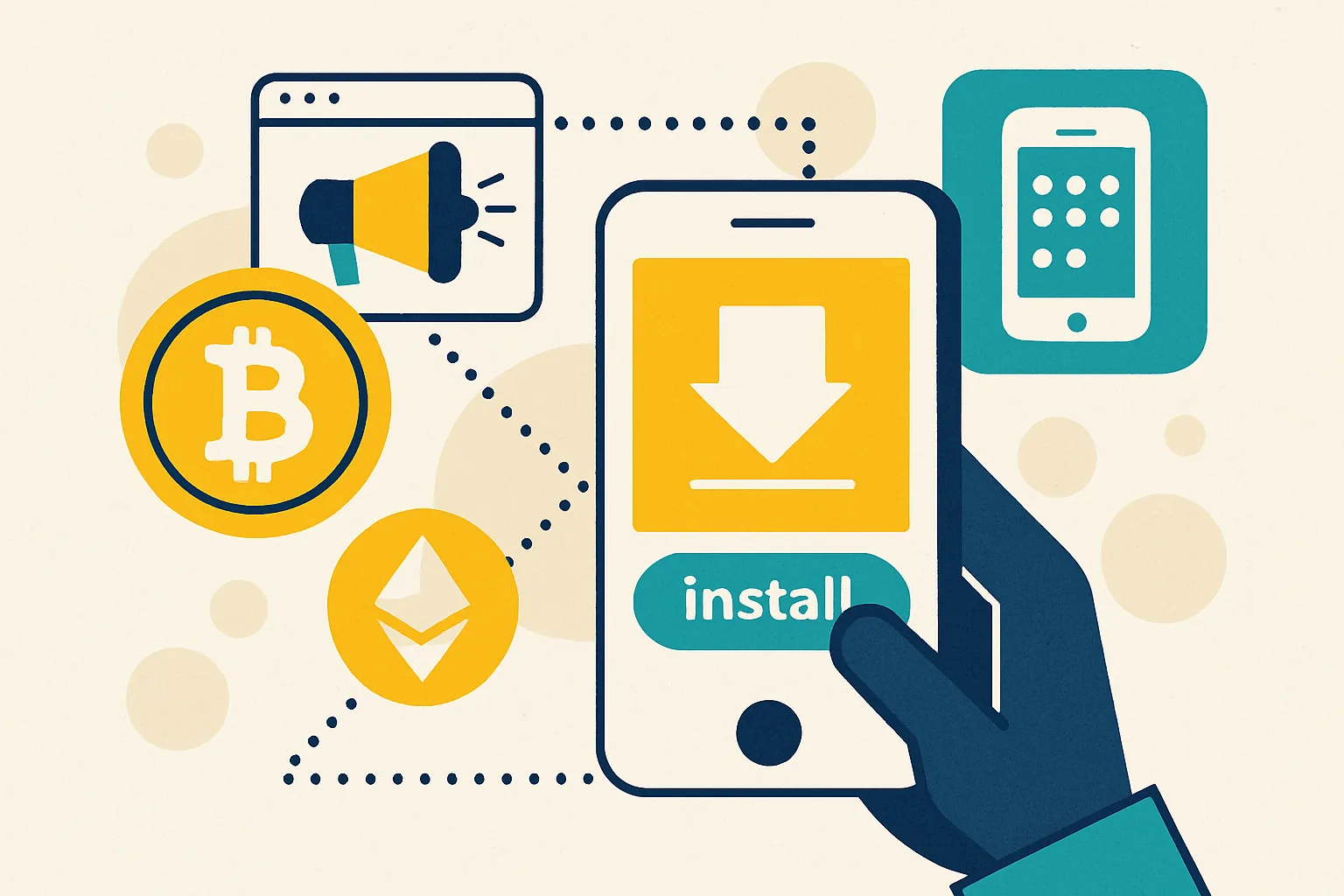
What a crypto ad network is and why it matters for app install campaigns
A crypto ad network is a traffic source built around publishers, audiences, and inventory that naturally overlap with crypto, fintech, and digital-first users. In practice, that can mean crypto media sites, wallet-related content, exchange-adjacent publishers, newsletter placements, and app ecosystems where users are already comfortable with wallets, payments, and fast-moving products. For app install campaigns, that matters because the audience is often more open to trying new apps, especially if the app solves a financial, trading, payments, or community problem. In that sense, a crypto ad network for app install campaigns can be a strong fit when the offer aligns with user intent.
Not every mobile app belongs in crypto inventory, of course. A generic game or utility app may do better elsewhere. But if the product has any connection to trading, rewards, wallets, education, DeFi, portfolio tracking, or digital assets, the fit can be strong. The point is not simply “crypto traffic.” It is relevant traffic with a higher likelihood of understanding the offer without a long explanation.
This is where the value of a specialized network becomes clearer. A broad network can deliver scale, but a focused crypto ad network can reduce the friction between impression and action. If your acquisition goal is installs, and especially if you need users who are likely to engage after the install, relevance often beats raw reach. For a deeper look at how crypto ad ecosystems function from the publisher side, see Crypto Ad Network for Publishers.
There is also a practical angle. Crypto audiences tend to be used to comparing offers, testing tools, and moving quickly when a product looks credible. That does not guarantee conversion, but it does mean your creative and app store flow must be sharp. A vague pitch is easy to ignore. A clear utility story gets a chance.
How mobile app install ads work across crypto and Web2 traffic
Mobile app install ads usually follow a simple path: a user sees the ad, taps it, reviews the offer, and installs the app from the relevant store or a direct download route. The mechanics are straightforward, but the way they perform can differ a lot between crypto-specific inventory and broader Web2 traffic.
In crypto-focused placements, the ad environment often includes editorial pages, listicles, comparison articles, wallet and exchange content, or community-driven pages where users are already in a “research” mindset. In Web2 environments, installs may come from more general apps, media, and content sites, where the audience is wider but less specialized. Both can work. The right mix depends on the app, the offer, and the level of education required before the install.
Common formats include display banners, native placements, in-article ads, popunders in some cases, and mobile-friendly units built for tap-through behavior. For app install ads, native and in-content units often perform well because they feel less disruptive and better support a short explanation of the product value. That said, a product with a strong visual identity may do better with a cleaner banner that gets to the point fast.
Targeting is usually layered rather than singular. Advertisers may combine geo, device type, operating system, browser, language, and contextual placement. On the crypto side, you can often add audience intent by selecting publishers or categories that already attract users interested in trading, wallets, or market news. On the Web2 side, broader behavioral and contextual signals can help capture more volume. The art is in balancing reach with relevance, not in chasing one metric in isolation.
The conversion flow also matters. A user may click an ad, land on a pre-lander or app page, then continue to the app store, or they may go directly to the store listing. Each step introduces friction. If the app is unfamiliar, a pre-lander can warm the user up and improve install intent. If the product is already obvious, extra steps may only slow things down. There is no universal answer; there is only the flow that best matches the offer.
CPA app campaigns: when cost-per-action fits app installs
CPA app campaigns are built around paying for a defined action rather than for traffic volume alone. In an install context, that action may be the install itself, or it may be a deeper event such as account creation, first deposit, onboarding completion, or another meaningful in-app milestone. CPA is attractive because it shifts some of the risk from the advertiser to the traffic plan: you are paying for outcomes, not just clicks.
This differs from CPC and CPM buying. CPC is about the click, which can be efficient but still leaves conversion risk entirely on the advertiser. CPM is about impressions, which is useful for reach and testing, but it tells you very little about intent unless the creative and placement are highly controlled. CPA app campaigns sit closer to performance marketing reality. They are best when you already know what a “good” user looks like and can define the action that matters.
For install growth, CPA can work especially well when the app has a clear funnel. Think of a trading app that values not just the install but the first completed verification. Or a wallet app where success depends on setup, activation, and repeat use. If the goal is only cheap installs, CPA may be too restrictive. But if the goal is quality acquisition, it can be the right buying model.
There is also a planning benefit. CPA forces discipline. You have to define the funnel before launch, which usually means fewer surprises later. That said, the model only works if your tracking is reliable and your optimization window is realistic. Otherwise, you end up optimizing to the wrong signal and wondering why users disappear after the first session.
Choosing the right app install offer, creative, and landing flow
The best app install campaigns line up the offer, the creative, the landing experience, and the store page so they all tell the same story. If the ad promises speed, the app page should reinforce speed. If the ad emphasizes security, the landing flow should make trust visible immediately. Mismatched messaging is one of the fastest ways to waste media spend.
Start with the offer. What is the main reason someone should install now rather than later? For a crypto app, it might be easier portfolio tracking, faster wallet access, lower-friction onboarding, alerts, or a simpler way to manage assets. Keep the offer concrete. “Better crypto tools” is weak. “Track holdings in one place” is stronger. “Open a wallet in minutes” is better still, if you can support it honestly.
Creative should do two jobs at once: attract attention and pre-qualify the user. A great install ad is not just visually polished; it is honest about who the app is for. Screenshots, short benefit-led headlines, and interface previews often outperform abstract branding. If the app has a distinctive feature, show it. People install tools they understand.
The landing flow is where many campaigns lose momentum. A direct-to-store approach is efficient when the audience is warm and the product is easy to grasp. A pre-lander can help when the audience needs context, comparison, or reassurance. For example, a short page that explains “what this app does, why it matters, and what happens after install” can be enough to raise install intent without becoming a distraction.
App store optimization is part of the same system. Title, subtitle, screenshots, ratings, and description all shape conversion. If your ad sells one promise and the store page tells a different story, users hesitate. The campaign may still get clicks, but installs become expensive. Align everything before scaling.
Tracking installs, events, and post-install quality
Tracking is the backbone of app install acquisition. Without it, you are buying guesses. At minimum, you need attribution that can connect the click or impression to the install, and ideally to deeper in-app events that show whether the user is actually engaged. A simple install count is rarely enough for serious optimization.
Most app teams rely on an SDK, an MMP, or both, depending on the stack. The important part is consistency: install events, session starts, registration, tutorial completion, onboarding milestones, and any revenue-related events should be mapped before launch. If you wait until the campaign is live to define event logic, you are already behind.
Quality signals matter just as much as volume. Watch for users who open the app once and vanish, users who install but never register, or users who complete the install but fail to reach a meaningful activation point. Those patterns usually indicate either a targeting issue, a creative mismatch, or a funnel problem inside the app itself. Sometimes the traffic is fine and the onboarding is the real leak. That is an awkward discovery, but a useful one.
It also helps to separate attribution windows and optimization windows. A user may install quickly but activate later. If your model only rewards immediate action, you may starve the campaign before the better users have time to convert. On the other hand, if you wait too long, you risk scaling poor inventory. The right balance depends on the app category and the event you choose as your north star.
For planning around broader crypto ad mechanics and how campaign economics are structured, it can be useful to review crypto ad network pricing models or the English overview in the Crypto Advertising: The Complete 2026 Guide | Adgora.
Targeting users in crypto-friendly audiences without wasting spend
Crypto-friendly audiences are not one single group. Some users are traders. Some are builders. Some are casual readers who check prices once a day. Others are only loosely adjacent to crypto through fintech, wallets, and payment tools. If you target all of them the same way, your results will usually flatten out. Good targeting is about separating intent from curiosity.
Contextual placement is often the cleanest starting point. If your app is connected to trading, portfolio tracking, or digital assets, placing ads beside relevant editorial content can create a natural match between mindset and message. That does not mean every crypto article converts. It means the user is already in the right mental neighborhood.
Geo and device settings deserve careful attention. Some apps only make sense in certain regions because of language, regulations, or product availability. Others perform better on iOS, Android, or specific device tiers due to interface complexity or user behavior. These are not minor details. They can decide whether your install campaign looks promising or stalls on day two.
Another useful tactic is to think in layers. Start with obvious relevance, then narrow based on performance. For example, you might begin with a set of crypto publishers and a few compatible geos, then isolate the placements that produce not just installs but activated users. This is slower than blasting broad traffic, but far cheaper in the long run.
The main thing to avoid is paying for “crypto interest” when what you really need is product-fit intent. Someone reading market headlines may click anything with a familiar logo. That is not the same as someone ready to install and use your app. Respect the difference and budget accordingly.
Common mistakes in crypto app install acquisition
One of the most common mistakes is treating all installs as equal. They are not. A cheap install from a weak placement can look attractive in a dashboard and still be nearly useless. If the user never opens the app again, the campaign did not really succeed, it just produced a number.
Weak creatives are another frequent issue. Many advertisers lean too hard on branding and not hard enough on clarity. If the visual does not explain the app quickly, users scroll past. If the claim is too broad, they click out of curiosity and bounce when the app page does not match the ad. Good creative has focus.
Mismatched incentives can also distort results. If a campaign is optimized around bonuses, giveaways, or rewards, it may attract users who want the incentive rather than the product. That can inflate installs while depressing retention. Incentives are not inherently bad, but they need to be handled with caution.
Then there is the classic problem of over-optimization. Advertisers often chase the cheapest inventory first, assuming the lowest cost per install will lead to the best outcome. In reality, the cheapest traffic may be the most expensive traffic once you look at post-install behavior. It is better to pay a little more for users who stay.
Finally, many teams launch with too little testing structure. No clear hypothesis, no creative rotation, no placement review, no event comparison. When that happens, every result looks random. A good campaign has a learning agenda from the start.
A practical launch checklist for your first campaign
If you are preparing your first crypto app install campaign, keep the setup disciplined. The more organized your launch, the faster you can tell what is working.
- Define the single primary goal: install, registration, activation, or another event.
- Confirm the app store flow is live, accurate, and aligned with the ad promise.
- Set up attribution through your SDK, MMP, or pixel stack before traffic begins.
- Map every key post-install event you want to monitor.
- Prepare at least a few creative variations with different hooks and visuals.
- Choose placements or publisher categories that match your app’s use case.
- Start with a manageable geo and device split so results are easier to read.
- Decide in advance what triggers a pause, a tweak, or a scale-up.
- Review early data for quality, not just raw installs.
- Keep notes on which audiences, creatives, and landing flows produce activated users.
Once the campaign is live, optimize in layers. First, remove obviously poor placements or creative fatigue. Next, compare traffic quality by device, geo, and publisher type. Then examine whether your store page or pre-lander needs adjustment. Only after you have enough signal should you increase spend in a meaningful way.
Scaling is not just “more budget.” It is more budget on a pattern that already makes sense. If you can identify the audience cluster, creative angle, and landing flow that produce consistent post-install quality, the rest becomes much easier. That is the real advantage of working with a crypto ad network for app installs: not just reach, but a cleaner path from attention to action.
And if you want to keep refining your approach, browsing broader Adgora resources can help. The market changes quickly, and the best operators treat every campaign as both a media buy and a learning loop. In app acquisition, that habit tends to pay for itself.
Terms in this article
Short definitions from the Adgora glossary.
- Creative
- The actual ad shown — the image, headline, text or video file plus its landing URL. Reviewed before it can serve.
- Offer
- A specific thing being advertised with a defined payout for a defined action — the unit of CPA. See the CPA marketing guide.
- CPA
- Cost per action — you pay only when a defined action happens: a sale, a signup, a deposit. The lowest-risk model for the buyer and the highest bar…
- Conversion
- The action you are actually paying for — a sale, signup, deposit or install. Conversions are idempotent on Adgora: the same click ID and offer will…
- Impression
- One ad served to one user, once.
- Attribution
- Deciding which click gets credit for a conversion. On Adgora that is the click ID match, which is why passing it is non-negotiable.
- CPC
- Cost per click — you pay only when someone clicks. The bid you set is the most you will pay for a click; the auction often clears lower. Best when…
- CPM
- Cost per mille — the price for one thousand impressions, paid whether or not anyone clicks. You are buying attention rather than actions, which sui…
Frequently asked questions
What is a crypto ad network, and why does it matter for app install campaigns?
A crypto ad network is a traffic source made up of publishers and audiences that naturally overlap with crypto, fintech, and digital-first users. It matters because this audience is often more receptive to new apps, especially when the app has a financial, trading, payments, or community use case.
Which kinds of mobile apps are a good fit for crypto ad inventory?
Apps connected to trading, rewards, wallets, education, DeFi, portfolio tracking, or digital assets tend to fit well. Generic games or utilities may perform better on other traffic sources unless they have a strong relevance to that audience.
How do mobile app install ads typically work across crypto and Web2 traffic?
Users see an ad, tap it, review the offer, and then install the app from a store or direct download route. Crypto traffic often comes from research-oriented placements like editorial or wallet content, while Web2 traffic is broader but less specialized.
When are CPA app campaigns a good choice for app installs?
CPA app campaigns are a good fit when you want to pay for a specific outcome, such as an install, account creation, or first deposit, rather than just clicks or impressions. They work especially well when the app has a clear funnel and you can define what a valuable user action is.
Why is the conversion flow important for app install campaigns?
Each step between the ad and the final install adds friction, so the flow should match the offer. A pre-lander can help warm up unfamiliar users, but if the product is already clear, fewer steps may improve conversions.
